
2025: mode of essence
on contigency, convictions, and Tractatus.

Dear 2024 me,
2024 ended with you spending time with family (visited Los Angeles for the new year). There were a lot of unprompted and contingent emotions that surfaced during the process of writing letters to your friends (which is yet another tradition that we started in addition to writing yearly review). You found yourself among these letters, perplexed by your own emotions, in the same way spending time with parents has a way of undoing every architecture that you’d built to live with the absurdity of adulthood: the gratitude of a healthy and fulfilling life angled with exhaustion of modern day capitalism, unrequisite love stemmed from spending more time with friends juxtaposed with with irritation of how “safe it feels”. The tranquility of a financially stable life mixed with an eternal angst.
Some letter reminded you of the good times in San Francisco, others calcified as if they were frozen in time. However, the general theme seemed to be a deep sense of appreciation and platonic love that you had for people in general. You did build yourself a routine, a version of yourself that 2017 Aaron would be proud (and even now, we are more than contempt with our own growth, and it didn’t seem to slow down at anytime soon.). Yet, some unresolved sediment did come up, more like questions you’d shelved without answering, which has permeates through and through.
This year is a bit different. Inspired by our favorite book this year, I borrowed Wittgenstein’s form—note that this list is largely phenomenological. The gaps between claims are intentional: some “therefores” gesture rather than entail,
and the ladder is more mnemonic than deductive.
***
preamble: I’m only include partial section of this lists given that I turned out to be quite lengthy, but you can find the full version of the text here with format a la Wittgenstein.
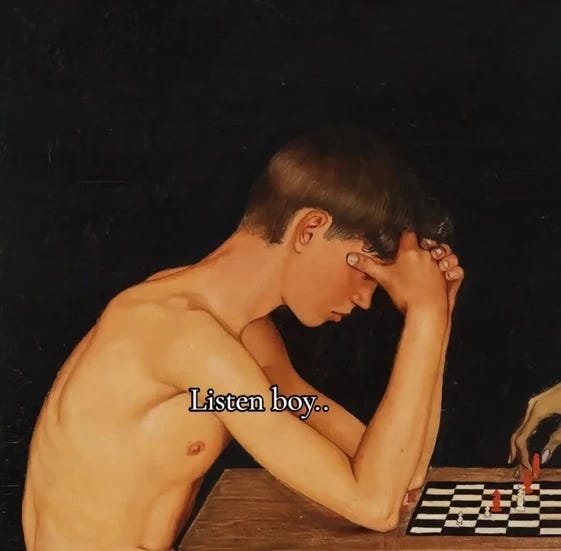
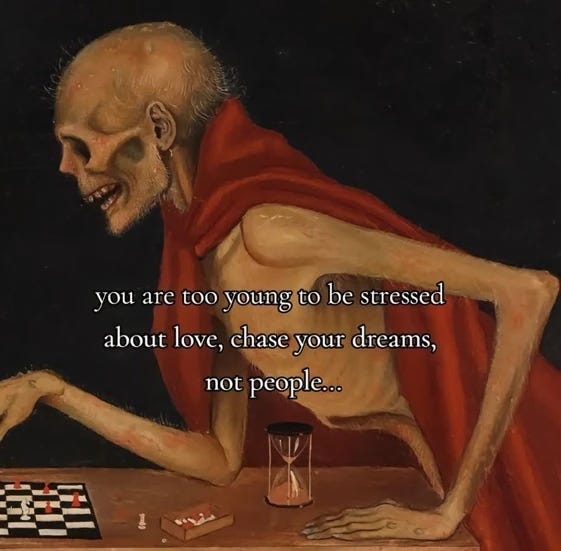
Whenever we speak of love, we risk sounding like fools.
Jacques Lacan
1. the world is a status function of the body
1.1 reconstitution has temporal structure, and some status function do not change instantaneously
1.11 dissolution requires withdrawal of maintenance, and withdrawal requires periods of stagnation, as attention reallocates gradually, not all at once.
1.12 constitution requires sustained engagement. A status function crystallised only after certain maintenance had accumulated.
1.13 a year is usually a good-enough frame for significant reconstitution. i.e the body that entered January differs from the body exiting December in which status functions it maintains
1.2 reconstitution requires stability and static anchor points in the constituting frame.
1.21 if environment shifts faster than consolidation, then nothing can form. You can’t build a house while foundation keep shifting.
1.22 staying in Toronto for a year yields more formidable results than constantly moving for the three years prior.
1.23 increase in outputs is not necessarily bounded in geographical locality but certain stability enforce gradual improvement rather than one-shot addition.
1.24 stability also enforces measurable status function: I loss around 3% body fat this year (healthier lifestyle), I run 5k consistently during summer period, I read thirty books this year, develop a framework that I’m comfortable with any given epistemic pursuits. This proves to provide longevity benefits.
1.241 stay-cations, capstone projects (morph, the text editor), workshops on LLMs inference at New Stadium—all of this required a stable frame.
1.3 reflection and embodied constitution operate on different substrates with different update dynamics.
1.31 reflection operates on propositions. propositions are discrete. “she is gone” can be accepted in a single cognitive act.
1.32 embodied constitution operates on synaptic weights. weights change via hebbian learning. hebbian learning requires repeated co-activation over time.
1.33 hebb: synaptic efficacy increases when presynaptic cell repeatedly and persistently takes part in firing postsynaptic cell. single activations are insufficient.
1.34 reflective update is instantaneous. embodied update is necessarily gradual.
1.4 the body is a Bayesian engine with strong priors accumulated through sustained engagement.
1.41 sleeping beside her encoded “this is her-side” across thousands of co-activations. the prior is strong.
1.42 a single observation—she is gone—cannot overcome a strong prior. Bayesian updating with strong priors requires accumulated counter-evidence.
1.43 grief is the lag between propositional update (instant) and distributional update (gradual). the reflective mind knows. the body has not yet accumulated sufficient counter-evidence.
1.5 canonical events are high-salience signals that accelerate but do not eliminate the lag.
1.51 normally attention reallocates gradually according to heuristics. canonical events override heuristics through salience.
1.52 November marked the two-days that I felt the most seen, followed by a week of self-recursive spiral into the valley of pain. High salience accelerated constitution. new status functions crystallized faster than normal bc attention concentrated so high.
1.53 when she said stop, high salience accelerated reflective deconstitution. but embodied deconstitution still lagged. the body had been constituting toward a telos from prior letters. those weights do not update in a day.
1.531 I crashed. dates felt pointless. sex felt like nothing. essentially, desire goes to zero.
1.54 therapy is supervised reconstitution. external agent helps calibrate which status functions to maintain, dissolve, or accelerate.
1.541 my new therapist actually reads what i send her and assigns homework. there’s a non-zero chance this approach works.

2. universal love is an emergent property of attention
2.01 love is a personal status function. X counts as beloved for this body in context C.
2.02 attention is a good primitive.
2.021 love, understanding, intelligence—they all decompose into sustained attention applied to an object. you cannot deeply understand what you haven’t attended to. you cannot love what you haven’t seen.
2.022 sustained attention generates a interpretive infrastructure, or the learned mappings between surface behavior and latent state.
2.0221 after two years you learn what her silence means when it’s thinking vs when it’s withdrawing. you learn the specific quality of voice that means she’s tired vs the one that means she’s hurt. this is expensive to build.
2.023 the infrastructure cannot be transferred. it’s specific to the dyad. when i started dating again, i kept misreading cues bc my interpretive machinery was calibrated to the wrong person.
2.024 hence deep relationships have high switching costs. you’re losing years of accumulated interpretive capital.
2.025 this year i discovered feelings that didn’t fit inside English grammatical structures.
2.0251 there’s a thing that’s not-quite-love and not-quite-friendship and not-quite-desire. it’s the feeling of being seen by someone whose attention itself constitutes you differently. L looked at me and I became a version of myself that only existed in her gaze.
2.0252 aristotle: “affection is no less present for inanimate things, but loving in return involves choice, and choice comes from an active condition.” the greeks had more words. we have to gesture.
2.0253 the speechlessness wasn’t failure. it was encounter with what genuinely exceeds the pictorial capacity of language.
2.026 what cannot be said can be shown—through practice, presence, the body’s testimony over time.
2.03 love emerges from sustained deployment of interpretive infrastructure.
2.031 sustained attention toward a person generates understanding of their particularity. you learn not “what women want” or “what people need” but what THIS person, with THIS history, in THIS moment, requires.
2.032 understanding generates care that exceeds rational justification. i cannot defend, in expected-utility terms, why her wellbeing matters more to me than a stranger’s. it just does.
2.033 care exceeding rational justification is love. the infrastructure for care is epistemically objective; the excess of care is ontologically subjective.
2.0331 this is where i was confused for three years. i kept searching for the romantic label when the substance was already present. the attention was there. the care was there. i was just waiting for permission from a category.
2.1 the mechanism of love is ontologically universal.
2.11 the universality of love operates regardless of cultural framing because it follows the universality of embodied cognition.
2.12 if i move to a different society, my cognition of love doesn’t change—even if my definition conflicts with what’s culturally sanctioned there. philosophical genealogy converges:
2.121 aristotle: philia requires sustained attention to the friend’s good.
2.122 murdoch: morality begins with a just and loving gaze directed upon individual reality.
2.123 hooks: love is verb. you cannot love what you have not attended to.
2.2 love cannot be propositionally verified.
2.21 scott alexander’s cactus person: the narrator asks DMT entities to factor a number—to provide propositional proof of their reality.
2.22 they refuse. “GET OUT OF THE CAR.”
2.23 i did this with N. not consciously. but the thing where you keep asking for confirmation, for evidence, for proof that the feeling is reciprocated—it’s the same demand.
2.24 the entities could factor the number. they refused bc the demand itself was the problem. asking “prove you love me” is demanding the beloved become object rather than subject.
2.25 the proof would destroy what it proves. verification requires objectification. love requires subjecthood.
2.3 the demand for proof is possession-logic.
2.31 possession-love treats the beloved as object to secure. attention-love treats the beloved as subject to attend to.
2.32 cultural scripts encode possession: “my person,” “other half.” as if the beloved were missing piece rather than whole person.
2.33 objects can be lost. possession-love generates anxiety, jealousy, fear. attention-love reduces these: presence without demand, care without contract.
2.34 attention-love doesn’t demand symmetric returns. you attend bc you want to see, not bc you expect equivalent attention back. asymmetric shapes can share the same substance.
2.4 therefore, love requires reciprocity of commitment, not reciprocity of kind.
2.41 she loved me as friend. i loved her otherwise. the shapes differed but the substance—attention, care, interpretive commitment—was shared.
2.42 when i stripped the romantic frame, love remained. the frame was superstructure. the attention was infrastructure.
2.43 you do not love someone if you override their articulated reality with your preferred interpretation. to love her meant accepting her frame, not imposing mine.
2.5 polyamory and monogamy are allocation of modes.
2.51 you can be monogamous with one person and polyamorous with another. the mode is person-dependent
2.52 this doesn’t change who you are. the circuitry is identical regardless of configuration.
2.53 the failure mode happens when transient relationships never accumulate infrastructure.
2.531 ended things with two partners end of this year, has to do with recent events that makes me evaluate my relationship consideration.
2.6 the capacity for asymmetric love is the capacity for neighbor-love.
2.61 kierkegaard: erotic love and friendship are preferential—i love you because you are beautiful, intelligent, kind. neighbor-love: i love you as such, independent of properties
2.62 preferential is unstable: if properties change, then love is threatened.
2.63 loving N asymmetrically—accepting friend when i wanted otherwise—was practice in non-preferential attention. the same muscle that lets you love someone through the parts of them that actively resist love.
2.7 therefore, universal love is neighbor-love at maximal scope.

Danaë, oil on canvas, Gustav Klimt (1907)

3. belief is the map drawn mostly in water
3.1 There are some core beliefs with respect to the existence of big-capital-G man for me.
3.11 I now believe the feeling-of-being-held is a real phenomenon, even if the map is mostly water there.
3.12 L showed up right when the old love was dissolving—the timing felt too aligned. the brain, being a meaning-engine, insisted there was signal in the noise.
3.13 still: there’s something there. events that feel like message, and a mind that can’t stop reading the world as text.
3.14 i don’t want to dismiss it as coincidence bc that’s too cheap; i also don’t want to canonise it as providence bc that’s too clean. the watermark shows where i used to be certain it was noise.
3.2 close reading has high ROI precisely bc it’s slow.
3.21 helps me become a better thinker this year.
3.22 being selective with books that refuse you to skim. The lossless process of connecting causal chain is meaning-making.
3.3 conversations in Toronto often feel like job interviews.
3.31 I suspect this might have to do with me being bad at questions, as the signalling are pretty low to gauge from the set of questions I have.
3.32 I notice the amount of people who have high agency are significantly lower comparing to the rest here. Essentially performing needle-in-a-haystack matching vibes.
3.33 Or I just need to learn more pop culture so conversation feels less like interrogation.
3.34 Most conversation here always seem to converge towards capital allocation. I’m a bit confused with this, as can’t we just talk about sewing, or bird facts, or a man juggling in the park.
3.35 sharing tacit knowledge without the performative masks—people often assume other intentions even when you’re being direct.
4. commoditising petaflops is the way forward in terms of timeline horizons
4.01 people seems to say that scaling is hitting the walls. I don’t really believe this.
4.011 we are nowhere near the compute efficiency ceiling of the actual hardware.
4.02 cost curves shows that we’ve yet to utilize fully what we currently have.
4.021 DeepSeek V3/R1 training with frontier performance for a fraction of the costs that used to train GPT-3.
4.022 This is then reflected within API pricing.
4.023 most deployments aren’t even running on the latest hardware, (i.e B200). Most optimized implementation currently looking at MBW (maximum bandwidth utilization) because data movement is expensive
4.024 MFU is heavily under-utilized. We will need co-design models that are inference-efficient. There are a lot of work tackling this problem, most notable is MLA
4.03 the bitter lesson still holds true.
4.031 one emergent axis is using test-time compute for long-horizon tasks. Apparently now what is considered frontier is how long “a model can one-shot a tasks in X amount of time.”
4.032 a cohesive, just-work inference engine seems to be the winning primitive for deploying in production.
4.1 Once intelligence become dirt cheap, what differentiate you from a-well-prompt-optimized-Claude?
4.11 prompting and steering models behaviour would then become essential skills, in addition to engineering efficiency
4.12 you still need to learn how systems work, because software engineering is not all about writing code. Understanding monads and concurrency systems is different from writing Go code.
4.121 Again, semantic is different from syntax.
4.2 Claude/Codex/Gemini can do a small part of my job. i still have to run a mental deslop filter.
4.21 80/20 point: last 20% of quality requires 80% of supervision. but that 80% of work that’s now trivial?
4.22 make versions you like. i have a psychopath claude, a thinking assistant, a writing partner. shape them into lossy compressions of yourself.
4.23 don’t use them to summarize. there’s learning in making the compression yourself.
4.3 Any type of interpretability work is worth doing.
4.31 the feeling of what i like in perfume translates to the feeling of what i like in activation space. persona vectors, counterfactual drift, the geometry of concept.
4.32 train a lot of muscle working with PyTorch, kernels, and spark a lot more interests in hardware knowledge, for me.
4.33 Did quite a bit of experiment. Most of them are throwaway
4.321 maybe I should publish failed experiments. This might produce valuable learning, perhaps.
4.4 tinyvllm needs finishing. a few research projects to test taste and vision.
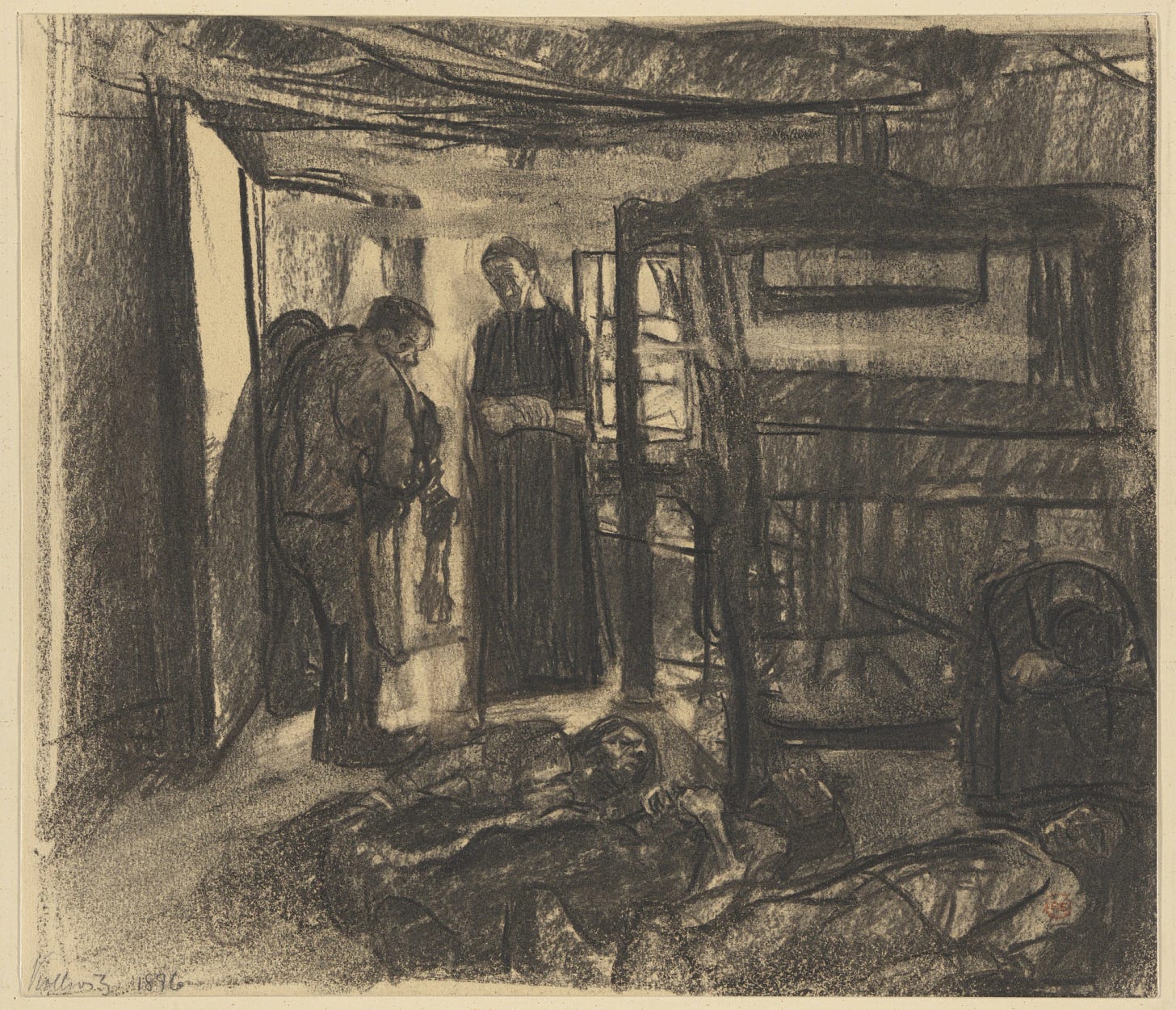
Study of End (Ende), Käthe Kollwitz (1896)
5. heuristics derived from phenomenological observation
5.1 conviction and taste are what remain valuable in hyperabundance
5.11 if you know what you like and think about it critically, it shows up in how you work. there’s no separating aesthetic from output. Just do the things you find beautiful.
5.12 discipline also helps in curating taste. A lot of ideas I have this year come from pushing weights and climbing.
5.13 hit the gym and bouldering way more this year. working toward triathlon, proper eating/sleeping/working schedule.
5.2 transparency and straightforwardness work.
5.21 it is ok to say no.
5.22 it is ok to tell people you like them upfront.
5.23 the push/pull model needs some refinement. be truthful without performing “here’s my heart, do as you will.”
5.24 i think i need to be a bit more selfish. can’t be good to everyone.
5.3 being autistic (or appearing more autistic than you are) is the performative-male version for technologists.
5.31 it’s ok. you’re not that unique. neither am i.
5.32 because we all know, there aren’t any original thoughts anymore.
5.4 life is suffering, but there are mitigations.
5.41 happiness is one. looking at beautiful things is another.
5.42 treat people how you want to be treated. this selfishly makes you feel better.
5.43 being a dick is resource-intensive. the expected utility is negative.
5.5 love as a proposition of logic: we feel belonging when in this mode, therefore we must find love.
5.51 but bc life is inherently suffering, finding love may be evasion from this true view.
5.52 “people only talk about their sun, but not enough people talk about the moon—in a way it reflects your soul.” this is poetry. treat it as poetry.
5.53 Just read books instead of scrolling Instagram, because scrolling are just suffering intensified.
[…]
8. books and reading that constitutes to character-building.
8.1 Tractatus Logico-Philosophicus — Ludwig Wittgenstein
8.2 The Gay Science — Friedrich Nietzsche
8.3 Waiting for God — Simone Weil
8.4 Letters to Milena — Franz Kafka
8.5 Crime and Punishment — Fyoor Dostoevsky
8.6 Either/Or — Søren Kierkegaard
8.7 HPMOR — Eliezer Yudkowsky
8.8 Radical Fun — Ava
8.9 Presence — Human Invariant
8.10 Please Don’t Throw Your Mind Away — LessWrong
8.11 Productivity — Alexey Guzey
8.12 Why Have Sex — Offhand Quibbles
8.13 A Constellation of Lookers — Henrik Karlsson
Your present self,